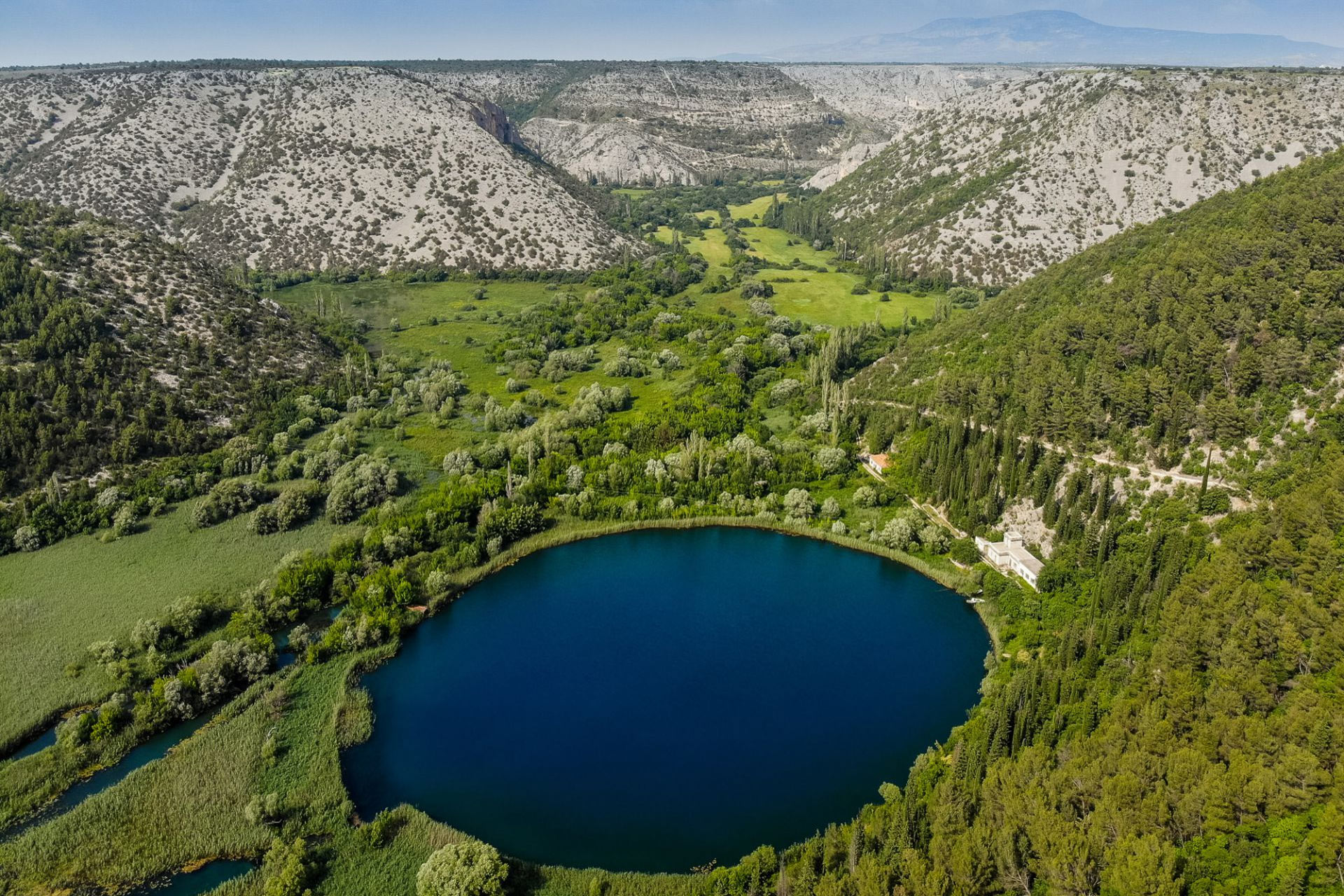
Čikola River Confluence
The confluence of the Čikola and Krka rivers represents one of the most extraordinary and unusual river meetings in Croatia, creating a unique hydrological phenomenon that exemplifies the complex water dynamics within Krka National Park. This remarkable junction occurs near Skradinski Buk and forms a fundamental component of the park’s water system, dramatically influencing the character and power of the region’s most famous waterfalls.
Geographical Configuration: The confluence is distinguished by its unusual configuration, where the two rivers are divided by Kalički Basin island and the extraordinary Torak Lake spring. This creates an almost mystical landscape where the powerful Krka River, flowing as a substantial waterway, meets the 3-kilometer submerged section of the Čikola River, which has been overwhelmed by the rising travertine barrier of Skradinski Buk. The visual impact is striking – on one side flows the broad, lake-like Krka, while the Čikola’s final kilometers disappear beneath the waters created by continuous travertine deposition.
Torak Spring – The Lake That Springs: At the heart of this confluence lies Torak Spring, a remarkable natural phenomenon that defies conventional understanding of typical springs. This circular, lake-like formation measures 150 meters in diameter and plunges to depths of 30 meters, creating what appears to be a mysterious lake at the base of dramatic cliffs. In reality, Torak Spring functions as a massive underground water source that resembles a lake more than a traditional spring, contributing significantly to the combined water volume that eventually cascades over Skradinski Buk.
Ecological Significance: The Čikola River system supports extraordinary biodiversity, including two exclusively endemic fish species: the Turkish chub (Telestes turski) and Dalmatian gaovica (Phoxinellus dalmaticus). During dry seasons, the Turkish chub demonstrates remarkable adaptation by retreating into groundwater systems, particularly seeking refuge in the Čikola spring area. This unique behavioral adaptation highlights the critical importance of the spring and confluence system for maintaining aquatic biodiversity.
Hydrological Impact: The confluence fundamentally transforms the character of the Krka River system. The combined waters of both rivers create the substantial flow that makes Skradinski Buk the powerful cascade complex it is today. Without this confluence, the famous waterfall would be dramatically different, lacking the volume and force that has made it one of Europe’s most impressive travertine cascade systems.
Seasonal Variations: The Čikola system experiences dramatic seasonal fluctuations, ranging from a substantial flowing river during wet periods to a significantly reduced presence during dry seasons. These variations directly impact the confluence dynamics and, consequently, the downstream water features throughout the park.
Springs and Sources
The spring systems of Krka National Park represent some of the most fascinating and complex water sources in the Croatian karst landscape, providing the lifeblood for the entire river system while showcasing the remarkable hydrological characteristics of this unique geological environment.
Primary Krka River Source: The source of the Krka River itself constitutes a remarkable triple-spring system located at the foot of Krševac hill, 3.5 kilometers northeast of Knin, at an elevation of 224 meters above sea level. This source complex demonstrates the intricate nature of karst hydrology through its three distinct permanent springs: the Main Spring, Small Spring, and Third Spring, each contributing different proportions to the total flow that initiates the Krka’s 72.5-kilometer journey to the sea.
The Main Spring: The Main Spring emerges from a cave (siphon) beneath the spectacular 22-meter high Topoljski Buk waterfall, contributing 80-95% of the total water volume from the Krka spring system. The flow from this primary source ranges dramatically from 1.5 to 10 cubic meters per second, reflecting the dynamic nature of karst water systems and their response to seasonal precipitation patterns. The spring’s cave setting creates a mysterious and powerful emergence point where substantial volumes of water appear from the depths of the karst underground.
Supporting Springs: The Third Spring and Small Spring, located on the left bank 50 and 150 meters downstream respectively, contribute the remaining 15-20% of the source flow. The Third Spring provides 3-5% of the total waters, while the Small Spring contributes 10-15%. These secondary sources demonstrate the dispersed nature of karst spring systems, where water emerges at multiple points rather than a single source.
The Krčić-Krka Connection: One of the most fascinating aspects of the Krka source system is its relationship with the Krčić River, which creates a unique hydrological phenomenon where an ending becomes a beginning. The Krčić River, originating at the base of Dinara Mountain and measuring 10.5 kilometers in length, terminates in the Topoljski Buk waterfall that flows directly into the Krka River spring. This creates the extraordinary situation where the Krčić’s mouth is simultaneously the Krka’s source, making Topoljski Buk both an ending and a beginning.
Seasonal Spring Dynamics: The visibility and character of these springs change dramatically throughout the year. During summer months when the Krčić riverbed dries up and Topoljski Buk lacks water, the main Krka spring becomes clearly visible. However, during winter and wet periods, the powerful Topoljski Buk waterfall completely covers the Krka spring, creating the illusion that no source exists beneath the cascading waters. This seasonal transformation provides visitors with entirely different experiences depending on timing.
Karst Spring Network: Beyond the primary source, the park’s spring system includes numerous smaller springs throughout the karst landscape. The southernmost karst spring in the protected zone is the Čikola spring in Petrovo Polje field, which demonstrates the intermittent nature of karst springs by flowing as a river during rainy periods but disappearing completely during dry seasons. This variability illustrates the complex underground water connections that characterize the entire Krka basin.
Geological Context: The spring systems exist due to specific geological conditions where impermeable rock formations create barriers for underground watercourses. The zone of impermeable rock around Knin and northward creates the conditions necessary for springs to emerge, while the permeable carbonate rocks allow surface water to sink into the karstified landscape, creating the underground networks that eventually emerge as springs.
Smaller Cascades and Pools
Throughout Krka National Park, beyond the seven major waterfalls, exists a remarkable network of smaller cascades, pools, and water features that create intimate water experiences and contribute significantly to the park’s overall aquatic character. These features range from modest travertine steps to substantial pools that provide habitat for diverse aquatic life and create countless photographic opportunities.
Travertine Pool Systems: The continuous process of travertine deposition throughout the park creates an intricate system of natural pools formed by calcium carbonate barriers. These pools vary dramatically in size, from intimate basins perfect for individual contemplation to substantial bodies of water that support complex aquatic ecosystems. The crystal-clear waters of these pools provide windows into the underwater landscapes, revealing the ongoing geological processes that continue to shape the park’s aquatic features.
Intermediate Cascades: Between the major waterfalls, numerous smaller cascades create stepping-stone effects as water moves through the landscape. These intermediate features often measure just a few meters in height but collectively contribute thousands of individual water features throughout the park. Each cascade represents a miniature example of the same travertine-building processes that create the major waterfalls, providing educational opportunities to observe geological processes on a more intimate scale.
Canyon Pool Systems: The deep canyon sections of both the Krka and Čikola rivers contain numerous pools created by variations in rock hardness and water flow patterns. These canyon pools often feature dramatically deep, emerald-colored water that contrasts beautifully with the white travertine formations and surrounding vegetation. Many of these pools support endemic fish species and provide critical habitat for aquatic organisms adapted to the unique karst water chemistry.
Seasonal Water Features: Many smaller cascades and pools throughout the park experience dramatic seasonal variations. During high water periods, temporary cascades appear throughout the landscape as overflow creates new water pathways. Conversely, during dry periods, many pools become isolated, creating unique aquatic islands that concentrate wildlife and provide opportunities for observing adaptation strategies.
Mill Pond Systems: The historic water mills throughout the park created numerous artificial pools and water diversions that have, over time, become naturalized features of the landscape. These mill ponds often support different ecological communities than natural pools and demonstrate the long history of human interaction with the park’s water systems. Many mill pond areas now provide excellent opportunities for wildlife observation and photography.
Underground Emergence Points: Throughout the park, smaller springs and emergence points create localized water features where underground streams surface briefly before rejoining the main river system. These features often create small oasis-like environments with unique microclimates that support specialized plant and animal communities.
Wetland Pool Complexes: In areas where the river valley widens, networks of interconnected pools create wetland environments that support marsh birds, amphibians, and specialized vegetation. These areas provide crucial habitat diversity within the park and demonstrate the range of aquatic environments that karst hydrology can create.
Photographic and Recreational Opportunities: The smaller water features throughout the park provide countless opportunities for intimate photography and peaceful contemplation away from the crowds that often gather at major waterfalls. Many of these features are accessible via the park’s extensive trail system, though some require more adventurous exploration to discover.
Conservation Significance: These smaller water features collectively represent critical components of the park’s ecosystem, providing habitat connectivity, supporting endemic species, and maintaining the complex water chemistry that enables ongoing travertine formation. Their preservation is essential for maintaining the ecological integrity of the entire Krka River system.
Visitor Information
Accessing Water Features: Many of the park’s secondary water features are accessible through the extensive trail system that connects all major areas. The 47 kilometers of educational walking trails provide access to numerous springs, pools, and smaller cascades beyond the main attractions.
Best Viewing Seasons: Spring offers optimal conditions for experiencing the full range of water features, when seasonal springs are active and water levels showcase the complete aquatic ecosystem. Early morning visits provide the best lighting conditions for photography and wildlife observation at smaller water features.
Educational Value: The diverse water features of Krka National Park provide exceptional opportunities to understand karst hydrology, ecological adaptation, and geological processes. The range from major waterfalls to intimate springs illustrates the complete spectrum of water features possible in karst landscapes.
Conservation Awareness: Visitors should maintain awareness that all water features within the park are part of an interconnected system where impacts in one area can affect the entire network. The delicate balance of karst hydrology requires careful protection to ensure these remarkable water features continue to flow for future generations.
The water features of Krka National Park extend far beyond its famous waterfalls, creating a complex aquatic wonderland that showcases the remarkable diversity possible within karst landscapes. From the mysterious confluence of two rivers to the triple-spring source system and countless smaller cascades and pools, these features collectively create one of Europe’s most remarkable freshwater ecosystems.